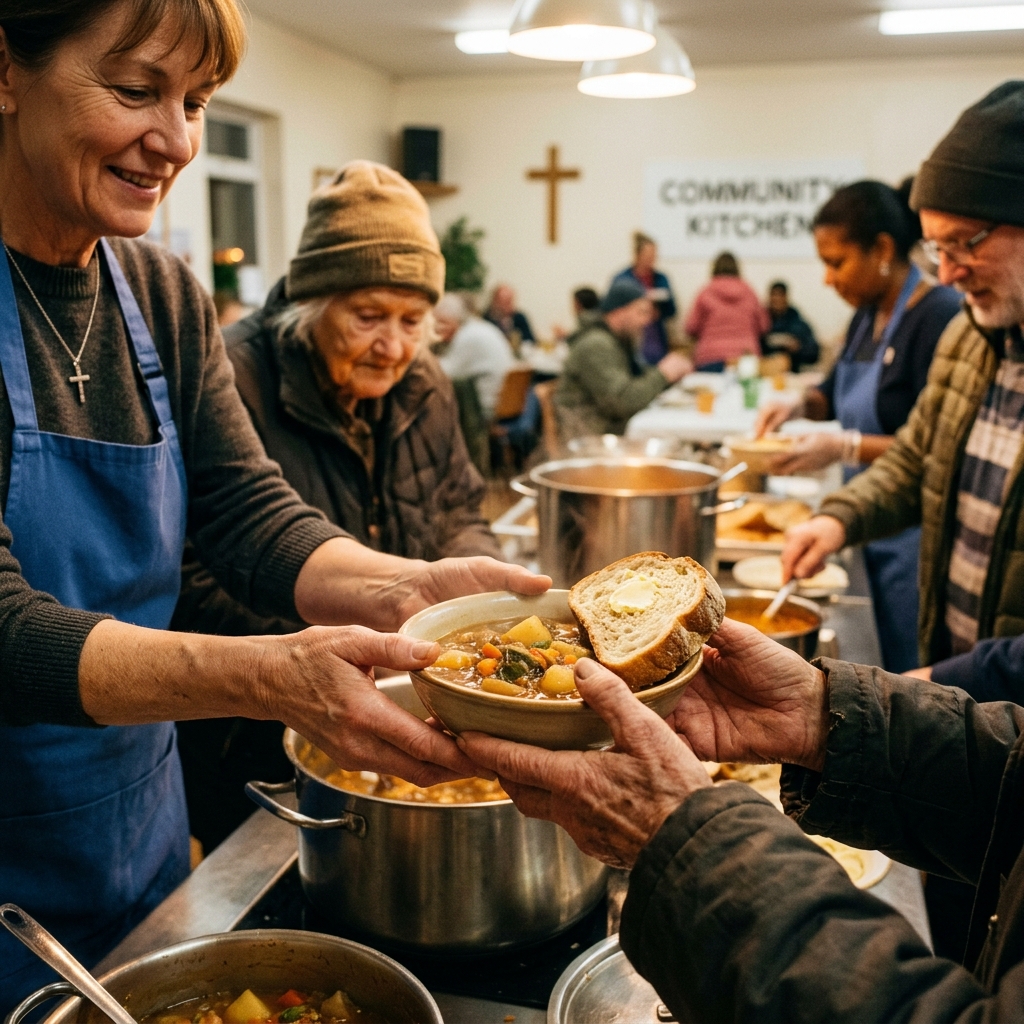
Poverty is among the oldest and most persistent challenges of human civilisation. Despite extraordinary technological and economic progress over the past century, hundreds of millions of people across the world still lack access to adequate food, clean water, housing, healthcare, and education. For the Christian, this is not merely a social policy concern — it is a theological one. The Bible speaks about poverty with a frequency and urgency that cannot be honestly ignored, and it speaks with equal directness about what God expects of those who follow Him in response to it.
God's Passionate Concern for the Poor
Any reading of Scripture that takes the whole text seriously must reckon with the overwhelming weight of God's declared concern for the poor. This is not a New Testament addition to an otherwise indifferent Hebrew tradition. From the earliest books of the Law, God's care for the marginalised is built into the very structure of Israelite society.
The gleaning laws of Leviticus and Deuteronomy required that farmers leave the edges of their fields unharvested, so that the poor could come and gather what they needed. This was not charity — it was law. The Sabbath year commanded that debts be released. The Year of Jubilee commanded the restoration of all alienated property to its original family, ensuring that economic inequality could not compound across generations without limit. These were not suggestions for the devout Israelite. They were the terms of the covenant.
The prophets — Isaiah, Amos, Micah, Jeremiah — return again and again to the sin of oppressing the poor as among the most grievous of national transgressions. Amos's searing indictment of Israel — 'they sell the innocent for silver, and the needy for a pair of sandals' (Amos 2:6) — reveals that God's patience with injustice has a limit, and that economic oppression is not a social issue but a spiritual one.
The Psalms are saturated with declarations of God's identification with the poor: 'He raises the poor from the dust and lifts the needy from the ash heap' (Psalm 113:7). The same God who rules the universe is intimately concerned with where the hungry will eat tonight. This is not incidental to who God is. It is essential.
Jesus and the Poor
The ministry of Jesus was characterised by a startling preferential attention to those on the margins of society. His first public proclamation, drawn from Isaiah 61, was a manifesto for the marginalised: 'The Spirit of the Lord is upon Me to proclaim good news to the poor, release to the captives, recovery of sight to the blind, to set at liberty those who are oppressed.'
Note that Jesus does not simply speak of spiritual poverty here. The Greek word used — ptochos — refers to destitution, to those who have nothing. Jesus came for those who have nothing. His incarnation was itself a kind of solidarity with poverty — born in a feeding trough, raised in a tradesman's workshop in an occupied land, with 'nowhere to lay his head' in his adult ministry.
In the parable of the sheep and the goats (Matthew 25), Jesus makes perhaps His most disturbing claim about the poor. Every person who fed the hungry, gave water to the thirsty, welcomed the stranger, clothed the naked, visited the sick and imprisoned — they were, in so doing, doing it to Jesus Himself. 'Whatever you did for the least of these brothers and sisters of Mine, you did for Me.' And conversely, whatever was withheld — it was withheld from Him.
This is not a comfortable passage. It does not permit the separation of devotion to Jesus from service to the poor. It brands them inseparable.
The Early Church's Response
The early church took these commands seriously to a degree that astonished the pagan world around them. The book of Acts records that 'there was no needy person among them, for from time to time those who owned land or houses sold them, brought the money from the sales and put it at the apostles' feet, and it was distributed to anyone who had need' (Acts 4:34-35).
This was not communism of the modern ideological variety. It was koinonia — the deep communal sharing of a people who had been transformed by the recognition that everything they had was a gift from God, held in trust for the common good. The early church's radical generosity was inseparable from their witnessing life. It was one of the primary reasons the pagan world found the Christian community compelling.
Julian the Apostate, the Roman Emperor who attempted to reverse the Christianisation of the empire in the fourth century, complained in frustration that 'the godless Galileans care not only for their own poor but for ours as well.' Their generosity was a form of evangelism.
Global Peace Ministry, in this tradition, understands charity not as an add-on to its spiritual ministry but as integral to it. Dr. Momodu has consistently taught that a ministry that preaches the Gospel without feeding the hungry is offering an incomplete Gospel — one that the hungry and destitute are right to receive with scepticism.
The Danger of Prosperity Without Responsibility
Scripture does not teach that wealth is sinful. Abraham was wealthy. Solomon was wealthy. Job, before and after his trials, was wealthy. The question is not whether one is prosperous but what one does with prosperity — whether it becomes a tool for service or a fortress of self-protection.
The parable of the rich man and Lazarus (Luke 16) is one of the most sobering passages in the Gospels. The rich man is not condemned for illegal activity. He is condemned, apparently, for indifference — for living a life of luxury while a hungry man lay at his gate, longing for scraps, and doing nothing.
The indictment is not that he made the man poor. It is that he did not see him. Or rather, that he chose not to see him. This kind of chosen blindness — the cultivation of an inner life that permits the pain of others to be filtered out, so that it does not disturb our comfort — is one of the spiritual dangers that prosperity uniquely creates.
The antidote is what Jesus called 'storing up treasures in heaven' — the intentional, disciplined re-directing of resources toward the Kingdom's priorities. The practice of giving generously — tithes, offerings, charitable giving — is not merely a financial discipline. It is a spiritual one. It trains the soul to hold material things loosely, to be what Paul calls a 'cheerful giver' precisely because the giver has been freed from the anxiety of possession.
Systemic Justice and Individual Charity
One of the important theological distinctions in Christian social ethics is between individual charity and systemic justice — between addressing the immediate needs of the poor and addressing the structural conditions that produce poverty.
Both matter, and neither is sufficient alone. Individual charity — feeding a hungry person, giving clothing to someone cold, contributing to a crisis fund — addresses the immediate need and is morally required of the Christian. But it does not change the conditions that produced the hunger.
Systemic justice — advocacy for fair wages, equitable access to education and healthcare, trade policies that do not impoverish developing nations for the benefit of wealthy ones, legal protections for migrant workers — addresses the conditions. It is also morally required, and it is deeply Biblical. The prophets were not merely running soup kitchens. They were indicting entire economic and political systems that ground the faces of the poor into the dust.
Global Peace Ministry operates in both dimensions. It meets immediate needs through its charitable ministry and it advocates — through Dr. Momodu's lecturing, writing, and public engagement — for a world order more consistent with the Biblical vision of justice and dignity for all.
What You Can Do
A teaching on poverty and responsibility that ends without practical application has failed its purpose. Here, then, are concrete invitations to action:
Give regularly and generously. Make charitable giving not an occasional impulse but a practised discipline — a first-fruits commitment rather than what remains at the month's end. The Global Peace Ministry's charity work is sustained by regular givers who have chosen to invest in the transformation of lives.
Learn the faces of poverty. Poverty is abstract until it is personal. Volunteer with a local food bank, a homeless shelter, a refugee support service. Allow encounters with people in need to inform not only your giving but your praying and your advocacy.
Speak up. Poverty is perpetuated in part by the silence of those who could speak. Write to your elected representative about the issues affecting the poor. Use your social media platform to raise awareness. Support organisations doing systemic advocacy.
Pray with intention. Include the poor in your regular intercession. Pray for specific nations where poverty is acute. Pray for wisdom for policymakers. Pray for the strength and resources of those doing frontline work with the marginalised.
The God who raises the poor from the dust has called His people to be among the instruments of that raising. This is not optional. It is the Gospel in practice.
Continue Reading
Explore more reflections, teachings, and testimonies from Global Peace Ministry.
← All Articles