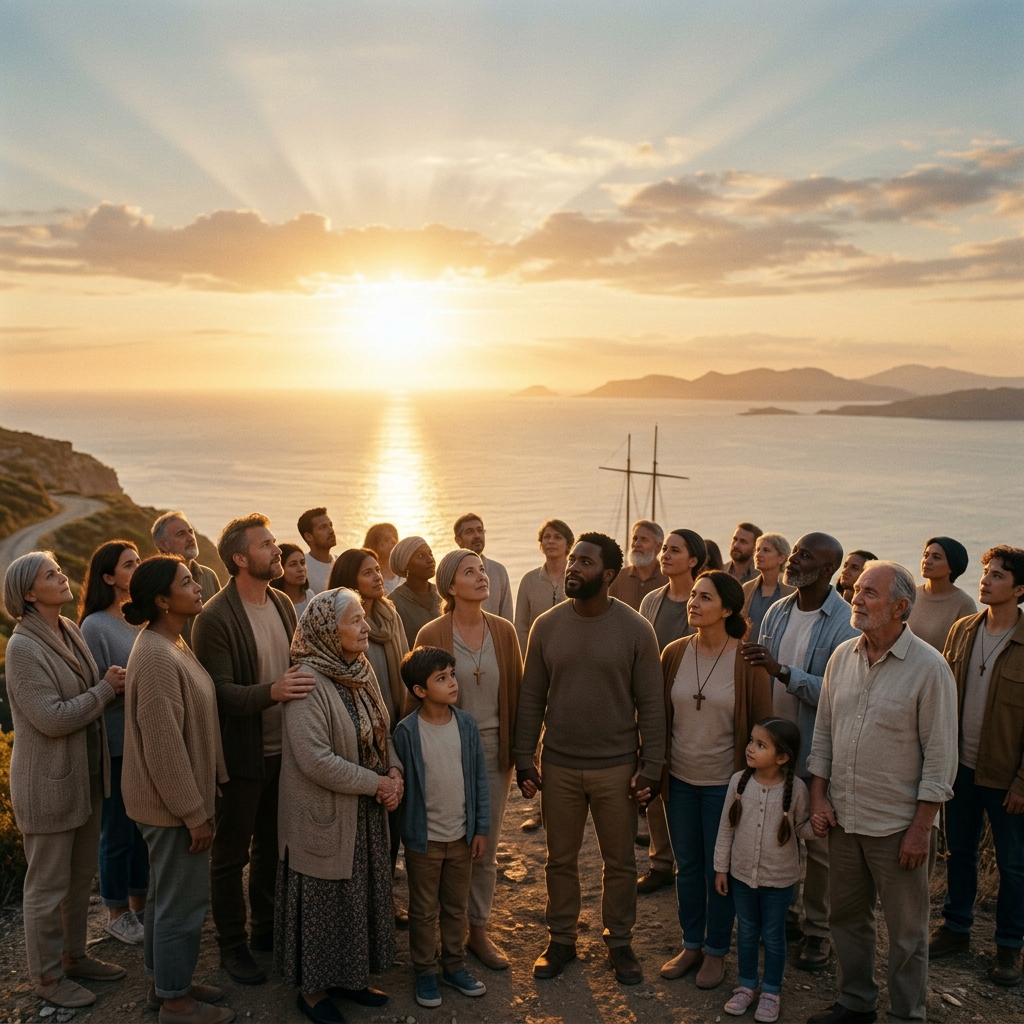
The question of whether global peace is attainable has occupied the minds of philosophers, theologians, and statesmen for millennia. To many, it remains a beautiful but naive aspiration — spoken of at podiums, prayed for in pews, and ultimately set aside as political reality intrudes. But Lord Professor Dr. Kingsley Kebiru Momodu, whose doctoral research and lifework centres on this very question, has arrived at a different and more urgent conclusion: global peace is not an idealist fantasy. It is a calling inscribed into the very nature of the human person.
The Spiritual Roots of the Peace Imperative
To understand why global peace is a calling rather than a dream, we must first go to where all callings originate — to the nature of God and His design for creation. The Hebrew word shalom, often translated merely as 'peace,' is in fact a far richer concept. It speaks of wholeness, completeness, and the alignment of all things with their intended purpose. When God looked upon creation and declared it 'good,' He was affirming a state of shalom — a universe at peace with its Creator, with itself, and with every living thing within it.
This was not an accident of language. It was a statement of divine intent. God's original design for humanity was not conflict, division, fear, or war. His design was flourishing — communities of people living in right relationship with God and with one another. The fall introduced rupture into this design. But the entire arc of Scripture from Genesis to Revelation is, at its heart, the story of God restoring what was broken. The Messiah is called the Prince of Peace, not merely as a title, but as a mission statement. Where He comes, shalom follows. The peace that Jesus brings is not the absence of conflict alone — it is the restoration of divine order, of right relationship, of wholeness.
To pursue global peace is therefore not a political project. It is a spiritual one. It is participation in God's own work of restoration in the world.
What History Tells Us About Human Longing
If one surveys history with an honest eye, they will find something remarkable beneath all its violence and struggle: a persistent and universal longing for peace. This longing is inscribed into the soul of every culture that has encountered the living God and found in Him the source and destination of all true peace.
St. Augustine, reflecting on his own restless journey toward God, articulated what countless men and women before and after him have experienced: 'our hearts are restless until they rest in Thee.' That restlessness is not merely a private spiritual aching — it expresses itself in the collective human yearning for a world without war, without hunger, without dehumanisation. The longing for peace is hard-wired into the human soul because we were made for it. The image of God — the Imago Dei — that every person bears is an image that includes the capacity and the desire for shalom.
The great Christian visionaries of history — from the early Church fathers who refused violence, to the medieval theologians who developed just war theory precisely to limit conflict, to the abolitionists who ended the slave trade on Biblical grounds, to the civil rights preachers who marched with Scripture on their lips — all drew from the same conviction: that the God of the Bible is a God of peace, and that His people are called to embody and extend that peace in the world.
Dr. Momodu, in his doctoral research at Kennedy University of Baptist, argues that this persistent longing is itself one of the strongest evidences that peace is achievable — because a longing without any possibility of fulfilment would be a cruel design flaw in human nature, and God is not cruel. The longing exists because it points toward something real.
The Peacemaker's Calling: A Biblical Mandate
Among the most revolutionary statements in the Sermon on the Mount is Matthew 5:9: 'Blessed are the peacemakers, for they shall be called children of God.' Note what Jesus does not say. He does not say 'blessed are the peaceful' — those who avoid conflict by passive withdrawal. He says 'blessed are the peacemakers' — those who actively enter into situations of tension and work to bring about reconciliation, healing, and restoration.
The word 'peacemaker' in Greek is eirenopoios — one who does or makes peace. It is an active, creative verb. It implies agency, effort, sacrifice, and skill. To be a peacemaker is to engage with the broken places of the world and labour, often at great personal cost, to see them made whole.
Throughout Dr. Momodu's ministry — from the youth of Lagos to the halls of London, from community halls in Romford to university lecterns across Europe — he has insisted on this active dimension of peacemaking. 'Peace does not fall from the sky into passive hands,' he has written. 'It is built, brick by brick, in the hearts and communities of those who dare to believe that things can be different.'
The calling of the peacemaker is therefore not reserved for diplomats and heads of state. It is the vocation of every believer who takes the Sermon on the Mount seriously. Every act of forgiveness is an act of peacemaking. Every instance of choosing dialogue over hostility, of extending dignity to the marginalised, of refusing to dehumanise the other — these are acts of peacemaking. Global peace begins in local hearts.
Barriers to Peace — and Why They Are Not Final
It would be intellectually dishonest to speak of global peace without acknowledging the magnitude of the obstacles before it. Wars rage on multiple continents. Ethnic hatreds calcified over generations resist every diplomatic effort. Economic systems that structurally advantage the wealthy and dispossess the poor generate the conditions in which violence flourishes. Religious extremism, nationalism, tribalism, and the trauma of historical injustices all feed the cycle of conflict.
Dr. Momodu is not naïve about these realities. His ministry has taken him to the palaces of the powerful and the dwellings of the destitute. He has sat with those consuming war and with those consumed by it. He is not offering a simplistic gospel that refuses to reckon with human darkness. He is, rather, offering a theological and practical conviction that no barrier, however entrenched, is more powerful than the redemptive grace of God working through willing human agents.
History bears this out. The abolition of the transatlantic slave trade was once considered politically impossible — until it wasn't. Apartheid South Africa was expected to end in a bloodbath — and yet emerged, imperfectly but remarkably, through the extraordinary grace of men and women willing to choose peace over vengeance. The Northern Ireland peace process confounded every cynic. These were not the achievements of utopian idealists. They were the fruit of hard, patient, costly peacemaking — often driven by people of deep faith who refused to accept that human destiny was fixed in darkness.
A Practical Theology of Peace
What, then, does a practical theology of global peace look like for the ordinary believer? Dr. Momodu offers several interconnected principles rooted in his ministerial experience:
First, peace must be cultivated inwardly before it can be extended outwardly. A person at war with themselves — with their past, their identity, their God — cannot authentically build peace in their community. Inner healing is not a luxury. It is the prerequisite for peacemaking. This is why the global peace ministry takes healing prayer and pastoral support as seriously as its advocacy work.
Second, peace requires listening. The peacemaker must be one who is slow to speak and quick to hear — who can sit with the grievance of the other without immediately defending or dismissing. Much of what passes for dialogue in our world is simply parallel monologues. True peace-building requires the discipline of genuinely hearing the other's pain.
Third, peace demands justice. The prophet Isaiah makes clear that there is no peace without justice — shalom is inextricably linked to righteousness. A peace that merely asks the oppressed to stop complaining while leaving the structures of oppression in place is not peace. It is management. Global peace ministry therefore involves advocacy for the poor, the voiceless, the forgotten — not merely as a social project but as a spiritual imperative.
Finally, peace is always sustained by prayer. Not prayer as a substitute for action, but prayer as the source of the vision, courage, and perseverance that action requires. Dr. Momodu has prayed in more cities, nations, and contexts than most ministers will visit in a lifetime. He carries with him the absolute conviction that prayer changes things — not as a platitude but as a demonstrated reality.
The Invitation
Global peace is not a dream reserved for the powerful or the privileged. It is a calling extended to every human being who bears the image of God. It begins not with governments or grand summits but in the hidden choices of ordinary people — to forgive, to listen, to refuse hatred, to advocate for the forgotten, to pray without ceasing.
At Global Peace Ministry, we believe that God is raising up peacemakers in every nation, every culture, and every generation. We believe that the same Spirit that hovered over the waters at creation and brought order from chaos is still moving — in Romford and in Nairobi, in Washington and in Warsaw, in the smallest village and the largest metropolis.
You are invited to be part of this movement. Not because it is easy. But because it is true. And because there is no more worthy calling to which a human life can be given than to this ancient, urgent, irreplaceable work: the making of peace.
Continue Reading
Explore more reflections, teachings, and testimonies from Global Peace Ministry.
← All Articles